
This guide explains how loan and mortgage payments are calculated, step by step: what a payment pays for, the formula lenders use, why the split between interest and principal changes over time, and what changes when you add taxes and insurance, pay extra, or borrow at 0%. The repayment process is called amortisation (spelled amortization in the US).
The worked examples use round, illustrative interest rates. They are not current rates or offers, and a calculation like this is an estimate, not a quote from a lender.
What a loan payment pays for
Each regular payment on an instalment loan, such as a car loan, a personal loan or a mortgage, does two jobs:
- Interest is the lender’s charge for lending you the money. Each month it’s worked out on the balance you still owe.
- Principal is the part that pays down the amount you borrowed, so the balance gets smaller.
Together these are often called P&I, for principal and interest. On a fixed-rate loan, the P&I payment is the same every month, but, as the Consumer Financial Protection Bureau (CFPB) explains in how paying down a mortgage works, the share going to interest and the share going to principal changes with every payment. The principal you’ve repaid on a home also builds your equity, the part of the home’s value you own outright.
A mortgage payment can include more than P&I. Property taxes and insurance are often added, which is covered in the PITI section below. The formula itself only deals with P&I.
The standard payment formula
Lenders work out a fixed monthly payment from three things: the amount borrowed, the interest rate and the length of the loan. The CFPB describes the same inputs in how mortgage lenders calculate monthly payments. The standard formula is:
payment = P × r × (1 + r)ⁿ ÷ ((1 + r)ⁿ − 1)
- P = the amount borrowed (the principal)
- r = the monthly interest rate = annual rate ÷ 100 ÷ 12
- n = the number of monthly payments
You don’t need to work it by hand, but it helps to know what it does. It finds the one payment that, made every month for n months, covers each month’s interest and leaves exactly nothing owed after the last payment. A higher rate, a larger amount or fewer months all raise the payment.
At a 0% rate the formula would divide by zero, so there’s a simpler special case: payment = P ÷ n. With no interest, you just split the amount into equal parts.
Worked example: a $10,000 loan
Take an illustrative $10,000 loan at 6% a year, repaid over 36 months. The monthly rate is 6 ÷ 100 ÷ 12 = 0.005, and n is 36. Putting those into the formula gives a monthly payment of $304.22.
Here’s what happens in the first month:
- Interest: $10,000 × 0.005 = $50.00
- Principal: $304.22 − $50.00 = $254.22
- Balance after the payment: $10,000 − $254.22 = $9,745.78
The second month’s interest is worked out on $9,745.78, so it’s a little lower, and a little more of the payment goes to principal. By the last payment, the interest is only $1.51. Over the whole loan you pay $951.90 in interest on top of the $10,000.
A small rounding note: figures here are worked out from the exact, unrounded payment and shown to the cent. A lender’s schedule rounds each payment, so its totals can differ by a few cents, often in the final payment.
How amortisation works
Amortisation is the process of paying off a loan in regular instalments, with each payment split between interest and principal. The CFPB explains amortisation with a car loan, but the mechanics are the same for any fixed-rate instalment loan. Every month:
- Interest = the balance × the monthly rate.
- Principal = the payment − that interest.
- The new balance = the old balance − that principal.
Because the balance falls each month, the interest falls too, and the fixed payment has more left over for principal. A table that lists this split for every payment is called an amortisation schedule.
Why early payments are mostly interest
Interest is charged on what you still owe, and you owe the most at the start. In the $10,000 example, the first payment includes $50.00 of interest and the last only $1.51. On a large, long loan the effect is much stronger.
Take an illustrative $200,000 mortgage at 6% over 30 years. The P&I payment is $1,199.10 a month. In the first month, interest is $1,000.00 and principal only $199.10. Put another way, about 83.4% of that first payment is interest ($1,000.00 ÷ $1,199.10). The principal share doesn’t overtake the interest share until month 223, more than 18 years into the loan.
A 30-year mortgage, year by year
The chart adds up each year’s 12 payments. Every bar is the same height, because the payment never changes; only the split does.
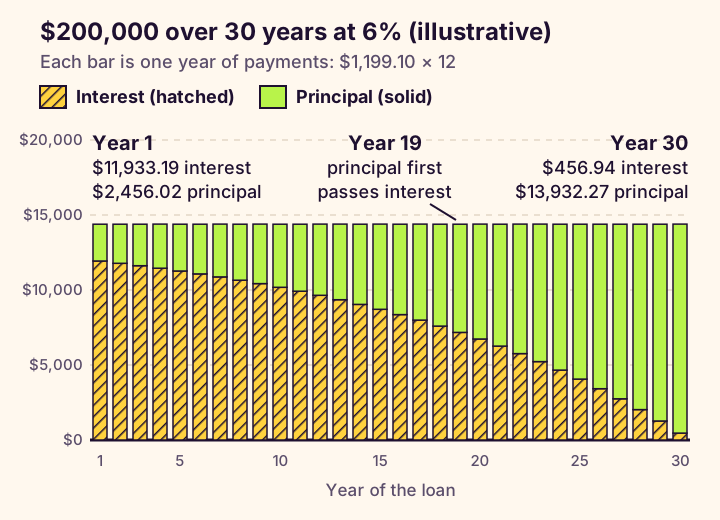
In year 1 you pay $11,933.19 in interest and only $2,456.02 in principal. In year 30 it’s the other way round: $456.94 in interest and $13,932.27 in principal. After 10 years of payments, $167,371.45 is still owed, which shows how slowly the balance falls at first. Over the full 30 years, the interest adds up to $231,676.38.
| Year | Interest | Principal | Balance at year end |
|---|---|---|---|
| 1 | $11,933.19 | $2,456.02 | $197,543.98 |
| 2 | $11,781.71 | $2,607.51 | $194,936.47 |
| 3 | $11,620.88 | $2,768.33 | $192,168.14 |
| 4 | $11,450.14 | $2,939.08 | $189,229.06 |
| 5 | $11,268.86 | $3,120.35 | $186,108.71 |
| 6 | $11,076.41 | $3,312.81 | $182,795.91 |
| 7 | $10,872.08 | $3,517.13 | $179,278.77 |
| 8 | $10,655.15 | $3,734.06 | $175,544.71 |
| 9 | $10,424.84 | $3,964.37 | $171,580.34 |
| 10 | $10,180.33 | $4,208.89 | $167,371.45 |
| 11 | $9,920.73 | $4,468.48 | $162,902.97 |
| 12 | $9,645.13 | $4,744.09 | $158,158.88 |
| 13 | $9,352.52 | $5,036.69 | $153,122.19 |
| 14 | $9,041.87 | $5,347.34 | $147,774.85 |
| 15 | $8,712.06 | $5,677.16 | $142,097.69 |
| 16 | $8,361.90 | $6,027.31 | $136,070.38 |
| 17 | $7,990.15 | $6,399.06 | $129,671.31 |
| 18 | $7,595.47 | $6,793.74 | $122,877.57 |
| 19 | $7,176.45 | $7,212.77 | $115,664.81 |
| 20 | $6,731.58 | $7,657.63 | $108,007.17 |
| 21 | $6,259.27 | $8,129.94 | $99,877.23 |
| 22 | $5,757.84 | $8,631.38 | $91,245.86 |
| 23 | $5,225.47 | $9,163.74 | $82,082.12 |
| 24 | $4,660.27 | $9,728.94 | $72,353.17 |
| 25 | $4,060.21 | $10,329.00 | $62,024.17 |
| 26 | $3,423.14 | $10,966.07 | $51,058.10 |
| 27 | $2,746.78 | $11,642.43 | $39,415.67 |
| 28 | $2,028.70 | $12,360.51 | $27,055.16 |
| 29 | $1,266.33 | $13,122.88 | $13,932.27 |
| 30 | $456.94 | $13,932.27 | $0.00 |
Figures calculated with the same maths as the Biberks Mortgage Calculator: fixed rate, monthly payments, no fees. Source for the mechanics: CFPB, How does paying down a mortgage work?
Loan term vs total interest
Stretching a loan over more months lowers each payment, but you pay interest for longer, so the total cost rises. The CFPB makes the same point about longer car loans. Here is the same illustrative $10,000 at 6% over three terms:
| Term | Monthly payment | Total interest |
|---|---|---|
| 24 months | $443.21 | $636.95 |
| 36 months | $304.22 | $951.90 |
| 60 months | $193.33 | $1,599.68 |
The 60-month loan has the lowest payment, but it costs more than twice as much in interest as the 24-month one. On a mortgage, the gap is bigger. The illustrative $200,000 at 6% over 15 years instead of 30 has a higher payment, $1,687.71 a month, but total interest of $103,788.46, less than half the 30-year figure.
Neither choice is right for everyone. A lower payment can make a budget work; a shorter term costs less overall. The point is to see both numbers before deciding.
Mortgage payments: P&I vs PITI
In the US, a monthly mortgage payment is often described as PITI: principal, interest, taxes and insurance. PITI is not the same as P&I. P&I repays the loan; the taxes and insurance are separate costs that are added on top.
According to the CFPB’s explanation of the difference between your principal and interest payment and your total monthly payment:
- The total monthly payment usually includes homeowners insurance and property taxes, often collected through an escrow account that the servicer uses to pay those bills.
- It may also include mortgage insurance.
- Homeowners association (HOA) fees are usually paid separately.
- On a typical fixed-rate loan the P&I part stays the same, but the escrow part can change as tax and insurance bills change.
PITI and escrow are US practice. Not every mortgage includes taxes and insurance in the payment, and arrangements differ outside the US, so check what your own payment covers.
An illustrative PITI breakdown
Here is the $200,000 example with purely hypothetical figures added: $2,400 a year in property tax and $1,200 a year in insurance. These are not typical or current amounts; real costs vary widely by location and policy.
| Part of the payment | Per month |
|---|---|
| Principal and interest (P&I) | $1,199.10 |
| Property tax (hypothetical $2,400 a year) | $200.00 |
| Insurance (hypothetical $1,200 a year) | $100.00 |
| Illustrative PITI total | $1,499.10 |
Only the $1,199.10 repays the loan. If the tax or insurance bill goes up, the total payment can rise even though the P&I part doesn’t change.
Extra payments
Paying more than the required amount can cut the total interest, because an extra payment that goes to principal lowers the balance, and every later month’s interest is worked out on that smaller balance.
How an extra payment saves interest
Here is the illustrative $200,000 mortgage at 6% over 30 years again, with a fixed extra amount added every month. The figures assume the extra money is applied to principal in the same month, every month from the first payment, with no penalty or fee.
| Extra each month | Paid off after | Sooner by | Interest saved |
|---|---|---|---|
| $100 | 295 months (24 years 7 months) | 65 months | $49,138.41 |
| $200 | 252 months (21 years) | 108 months | $79,800.51 |
Your own saving would be different. It depends on the amount, when you start, the rate, how much of the term is left and how your lender applies the money. Extra payments made early save more than the same payments made late, because there are more months of interest still to come.
Check how your lender applies it
Lenders and servicers don’t all treat extra money the same way. Some may count it as an early payment of a future instalment rather than a reduction of the balance. For student loans, the CFPB explains that extra payments may be applied to future payments, which can put a loan in “paid ahead” status, and suggests asking the servicer how they will be applied. Before paying extra on any loan, ask your lender or servicer how the payment will be used, and say that you want it to go to principal if that’s your aim.
Prepayment penalties
Some loans charge a fee for paying off early. The CFPB explains that a prepayment penalty may apply on some mortgages if you pay off the loan early. Not every loan has one. Your loan documents say whether yours does, and your lender can confirm it.
0% loans and “no interest” offers
A true 0% loan charges no interest at all, so there’s nothing to amortise in the usual sense. The payment is simply the amount divided by the number of payments. For example, an illustrative $1,200 at 0% over 12 months is $100.00 a month, with $0 interest. Every payment is principal.
Not every “no interest” offer works that way. A deferred-interest promotion is not a 0% loan. As the CFPB explains for “no interest if paid in full” credit card offers, interest can build up in the background during the promotional period. If you don’t pay the whole balance by the deadline, you can be charged that interest. Read the terms, and don’t assume the offer follows the P ÷ n pattern above.
Fixed, adjustable and other loan types
The maths in this guide is for fixed-rate, fully amortising loans, where the rate never changes and the regular payments pay the loan off completely by the end of the term.
- Adjustable-rate mortgages (ARMs): the CFPB explains that the rate on an ARM can go up or down after an initial period, so the payment can change. A single calculation at the starting rate can’t show the full cost.
- Balloon loans: the regular payments don’t repay the whole loan, and a large final payment is due at the end. The standard formula, which pays the loan off exactly over the term, doesn’t describe them.
If your loan is one of these, read the loan documents or ask the lender how the payment is worked out.
Checking the numbers yourself
You can try every example in this guide with Biberks calculators. They run in your browser and use the same formula.
- Work out a fixed loan payment and its total interest with the Loan Calculator. Enter the amount, the annual interest rate and the term; for 36 months, enter 3 years. Try different terms to compare total interest, as in the table above.
- See a yearly amortisation schedule with the Mortgage Calculator. Under Extras, add an extra monthly payment to see the interest saved, and your own estimate of taxes, insurance and fees to see the total monthly cost alongside P&I.
- Find what share of a payment is interest with the Percentage Calculator, using “A is what % of B”: $1,000.00 of $1,199.10 is about 83.4%.
Enter the interest rate, not the APR. The CFPB explains that the APR also includes points and other costs, so it isn’t the rate the payment formula uses.
A calculator result is an estimate based on what you enter. It isn’t a quote, an offer or an approval, and it isn’t financial advice. A lender’s figures can differ because of fees, rounding, the payment date and the exact terms of the loan.